
With everything happening in the world right now, it’s hard not to feel the weight. Violence, division, and despair seem to flare up daily, and many of us are left asking how much more we can hold.
As I’ve been sitting with this, one truth keeps rising: what we’re seeing isn’t just conflict or chaos. It looks and feels like trauma — not only in individuals, but at the level of society itself.
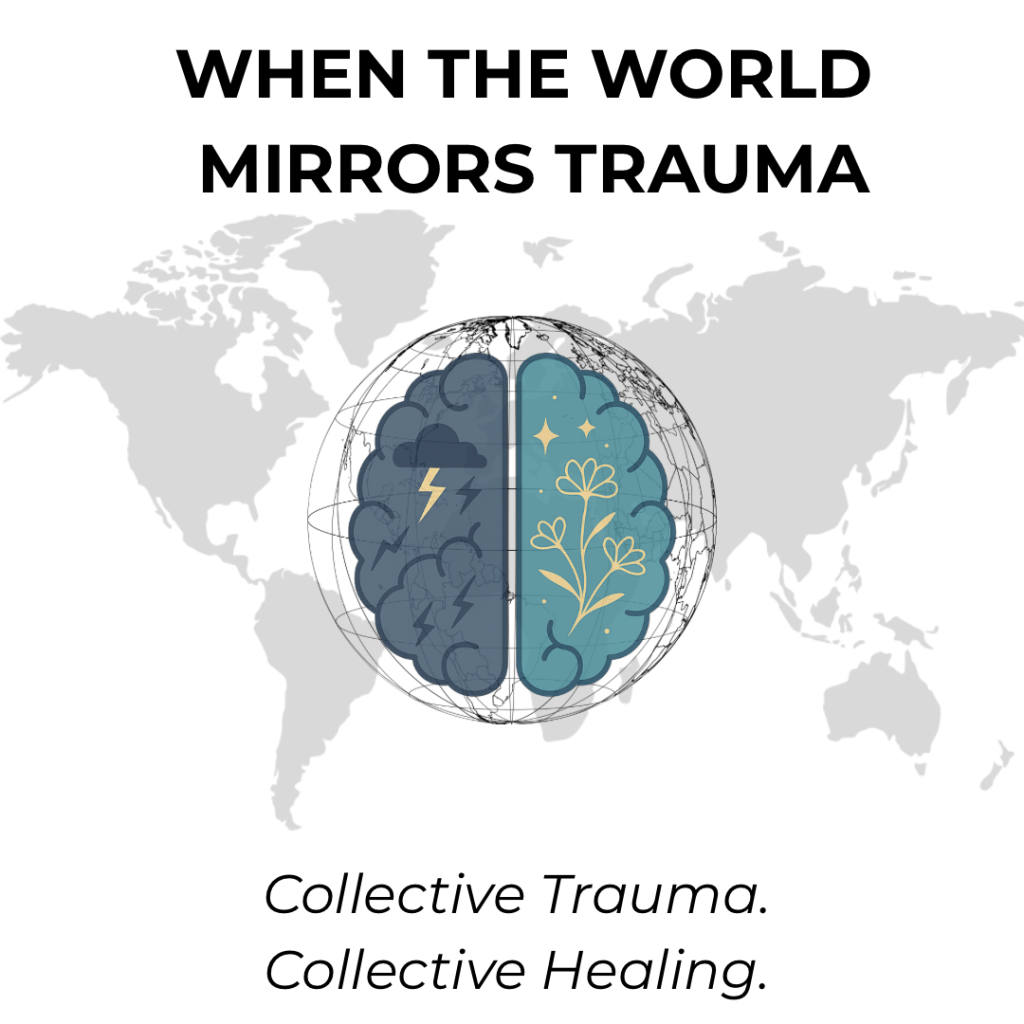
If mental illness can be remembrance at the individual level, then perhaps the world itself is remembering too — through trauma, reactivity, and cycles of pain that mirror a wounded nervous system.
Earlier, I wrote about what it means to see mental illness not as brokenness, but as remembrance — a call from the soul to be seen and healed. That was the individual lens. But healing never stops at the self. When we widen the view, another question emerges:
What if the world itself is mirroring trauma?
Trauma in the Brain
Neuroscience shows us that when someone is living with PTSD, the brain looks and acts differently. The frontal cortex — the place where empathy, creativity, and meaning-making live — goes quiet. Instead, the primitive brain takes over. It operates in survival mode: fight, flight, freeze, fawn.
When trauma is unresolved, especially from an early age, the brain wires itself to protect at all costs. A new trigger can send the body and mind into overdrive, reacting as if the past is still happening.
Society as a Traumatized Nervous System
Look around. Violence feels normalized. Outrage flares and fades in endless cycles. Many people are numb; others lash out. Empathy is in short supply.
Doesn’t this sound a lot like the symptoms of trauma?
Desensitization. Reactivity. Depersonalization. Survival mode.
It’s possible that what we’re experiencing globally is the accumulation of unresolved generational trauma. Hurt people hurt people — and when entire systems are built on cycles of harm, that pain echoes across decades.
The Hope: Healing Is Possible
The good news is this: brains can change. Neuroplasticity shows us that new pathways can form when we practice safety, reflection, and compassion. Just as an individual can rewire after trauma, so can communities.
When we pause instead of react, we re-engage the frontal cortex. When we reflect, we start to make meaning. When we create safety, we build space for empathy to come alive again.
That is resilience. Not the grit to just keep pushing, but the courage to heal, to soften, and to transform pain into connection.
A Personal Note
I know this not just from reading studies, but from my own life. Trauma has touched me in ways I once thought I’d never recover from. For a long time, I lived in reaction — protective, guarded, carrying pain I didn’t know how to release.
But healing taught me something profound: my brain, my heart, my spirit were never broken. They were protective. And when I gave myself safety and reflection, the parts of me that had gone quiet began to return — empathy, love, creativity, even joy.
That same healing is possible for all of us. What changes in me changes the world I touch.
A Reflection for You
Where do you notice yourself reacting out of survival instead of reflecting from safety?
How might you offer your brain, body, and spirit just a little more pause — a little more space — to re-engage with empathy?
Mantra
“As I heal, the world heals.
As I pause, the pathway to empathy opens.
I am part of the collective remembrance —
and my wholeness is a gift to the whole.”
About the Author
Jasmine Ayse Evans is a Project Manager in the tech industry and a Master’s student in Psychology. She writes and speaks at the intersection of technology, healing, and human potential.
Ms. Evans is a writer, speaker, and soul-led creator who believes clarity is a birthright and healing is a return, not a destination.
